Attributable to HPV. Source: (Walboomers et al., 1999); Cancer Research UK
What it is
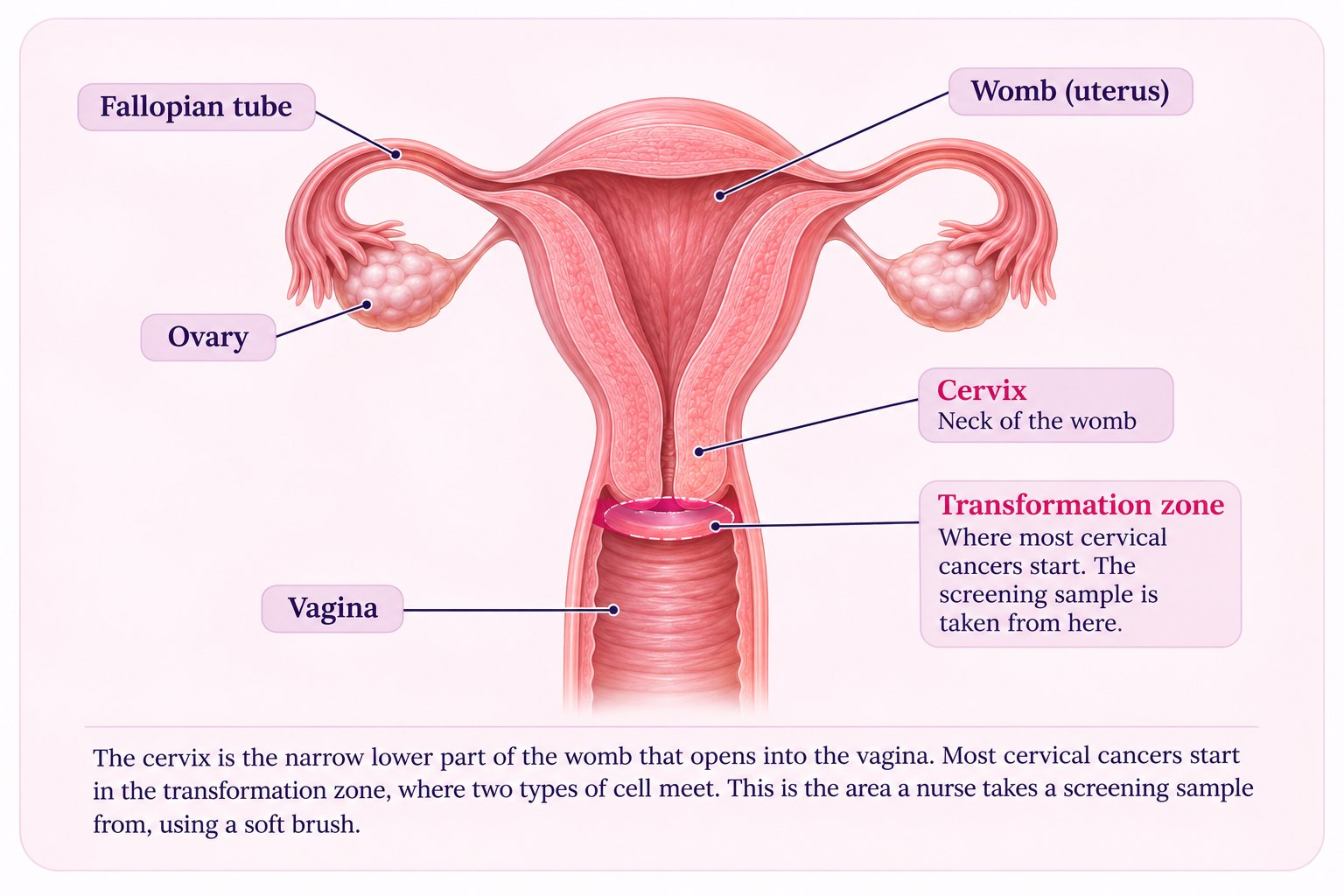
The cervix is lined with two kinds of cells: flat squamous cells on the outside and glandular cells in the canal leading to the womb. They meet in an area called the transformation zone. This is where most cervical cancers begin, and it is the area a nurse samples during cervical screening.
There are two main types. Squamous cell carcinoma starts in the squamous cells and makes up most cases. Adenocarcinoma starts in the glandular cells and makes up most of the rest. Cervical cancer can affect anyone with a cervix, including women, trans men and non-binary people.
Symptoms
- Vaginal bleeding during or after sex, between periods, or after the menopause
- Periods that are heavier than usual
- Changes to vaginal discharge, including a change in smell
- Pain during sex
- Pain in your lower back, between your hip bones (pelvis) or in your lower tummy
Early cervical cancer often causes no symptoms at all, which is why screening is so important. These symptoms are much more likely to be caused by something else, such as fibroids or endometriosis.
If you have any of these symptoms, see your GP. Don’t wait for your next screening invitation, even if your last result was normal.
Causes
Nearly all cervical cancers are caused by persistent infection with a high-risk type of HPV. Two types, HPV16 and HPV18, cause around 7 in 10 cases (de Sanjosé et al., 2010). One study found HPV in 99.7% of cervical cancers worldwide (Walboomers et al., 1999). Most HPV infections clear on their own within two years. Cancer only develops when an infection lasts for many years and causes cell changes that are not found and treated.
Cervical cancer is not inherited, and it is not caused by anything you did or didn’t do. HPV is extremely common and is passed on through any intimate skin-to-skin contact.
Statistics
Cervical cancer is the 14th most common cancer in women in the UK. It is most often diagnosed in people in their 30s. Rates have fallen by about a quarter since the early 1990s, mainly thanks to screening, and are expected to fall further as vaccinated generations reach adulthood. Source: Cancer Research UK.
Risk factors
- Persistent high-risk HPV infection, the main cause
- Smoking, which is linked to around 1 in 5 cervical cancers in the UK and makes it harder for the body to clear HPV (Brown et al., 2018)
- A weakened immune system, for example from HIV or medicines taken after an organ transplant
- Not attending cervical screening, so cell changes are not found early
- Other sexually transmitted infections, such as chlamydia
- Having several children, or having a first child before the age of 17
- Using the combined contraceptive pill for more than 5 years slightly increases risk. The risk falls again after stopping, and for most people the benefits of the pill outweigh this
- Having had vaginal, vulval, kidney or bladder cancer in the past
Having a risk factor doesn’t mean you will get cervical cancer, and many people who get it have no risk factors other than HPV.
How it develops
HPV reaches the cells at the base of the cervix lining through tiny breaks in the skin. In a persistent infection, the virus makes two proteins, E6 and E7. E6 breaks down p53, a protein that normally stops damaged cells dividing or makes them self-destruct. E7 switches off Rb, a protein that acts as a brake on cell division.
With these brakes removed, infected cells divide when they shouldn’t and gradually collect genetic damage. Sometimes the viral DNA becomes part of the cell’s own DNA, which can increase the amount of E6 and E7 the cell makes.
- CIN1: mild cell changes. These usually go back to normal on their own.
- CIN2 and CIN3: moderate to severe changes. These are usually treated, often with a simple procedure that removes the affected area.
- Invasive cancer: abnormal cells break through the layer beneath the lining and can spread.
This process usually takes 10 to 20 years, which gives cervical screening plenty of time to find and treat changes before cancer develops.
Diagnosis and treatment
If your GP thinks you need more tests, you’ll be referred to a specialist for a colposcopy, where the cervix is looked at closely and a small sample (biopsy) may be taken. Further scans help show whether a cancer has spread.
Treatment depends on the size and stage of the cancer and may include surgery, radiotherapy, chemotherapy, or a combination. Pre-cancerous cell changes found at screening can usually be removed in a quick outpatient procedure.
Prevention
- Go for cervical screening when invited. Regular screening prevents most cervical cancers.
- Get the HPV vaccine if you’re eligible. It adds an extra layer of protection.
- Stop smoking, which helps your body clear HPV.
- Don’t ignore symptoms. Screening is for people without symptoms, so see your GP if something changes.
Common misconceptions
"Cervical cancer can’t be prevented."
It’s one of the most preventable cancers. The HPV vaccine stops most cases before they start, and screening finds cell changes that can be treated long before they become cancer.
"I’ve had the vaccine, so I don’t need screening."
The vaccine covers nine HPV types, including the ones behind most cervical cancers, but not every high-risk type. Screening finds changes caused by the types it doesn’t cover.
"Having HPV means I’ll get cervical cancer."
Most HPV infections clear on their own. Only a long-lasting infection with a high-risk type can lead to cancer, and screening is designed to catch it first.
"Only people with lots of partners get cervical cancer."
Most people who have ever been sexually active will have HPV at some point. Cervical cancer can develop after just one partner.
"I haven’t had sex for years, so I’m not at risk."
HPV can stay in the body unnoticed for many years before causing cell changes, so keep going for screening even if you haven’t had sex for a long time.
"Cervical cancer only affects young women."
It’s most often diagnosed in people in their 30s, but it can affect people of any age. Around 1 in 10 UK cases are diagnosed in people aged 75 and over.
"A normal screening result means I can’t have any gynaecological cancer."
Cervical screening only checks the cervix. It can’t find cancers of the womb, ovaries, vulva or vagina, so see your GP about any unusual symptoms.
"Cervical cancer runs in families."
It isn’t caused by an inherited faulty gene. It’s caused by HPV. It can seem to run in families because of shared factors such as smoking, or not going for screening.
"Screening is only for women who have sex with men."
Screening is for everyone with a cervix aged 25 to 64, including lesbian and bisexual women, trans men, and non-binary and intersex people with a cervix.
"I feel fine, so I don’t need to go."
Early cell changes and early cervical cancer usually cause no symptoms. That’s exactly why screening matters.
Support and charities
- The Eve Appeal: gynaecological cancer information and the free Ask Eve nurse service
- Macmillan Cancer Support: practical, emotional and financial support for anyone affected by cancer
- NHS sexual health services: free, confidential testing and advice
NHS guidance
NHS and trusted information