Attributable to HPV. Source: (Schache et al., 2016)
Types of head and neck cancer
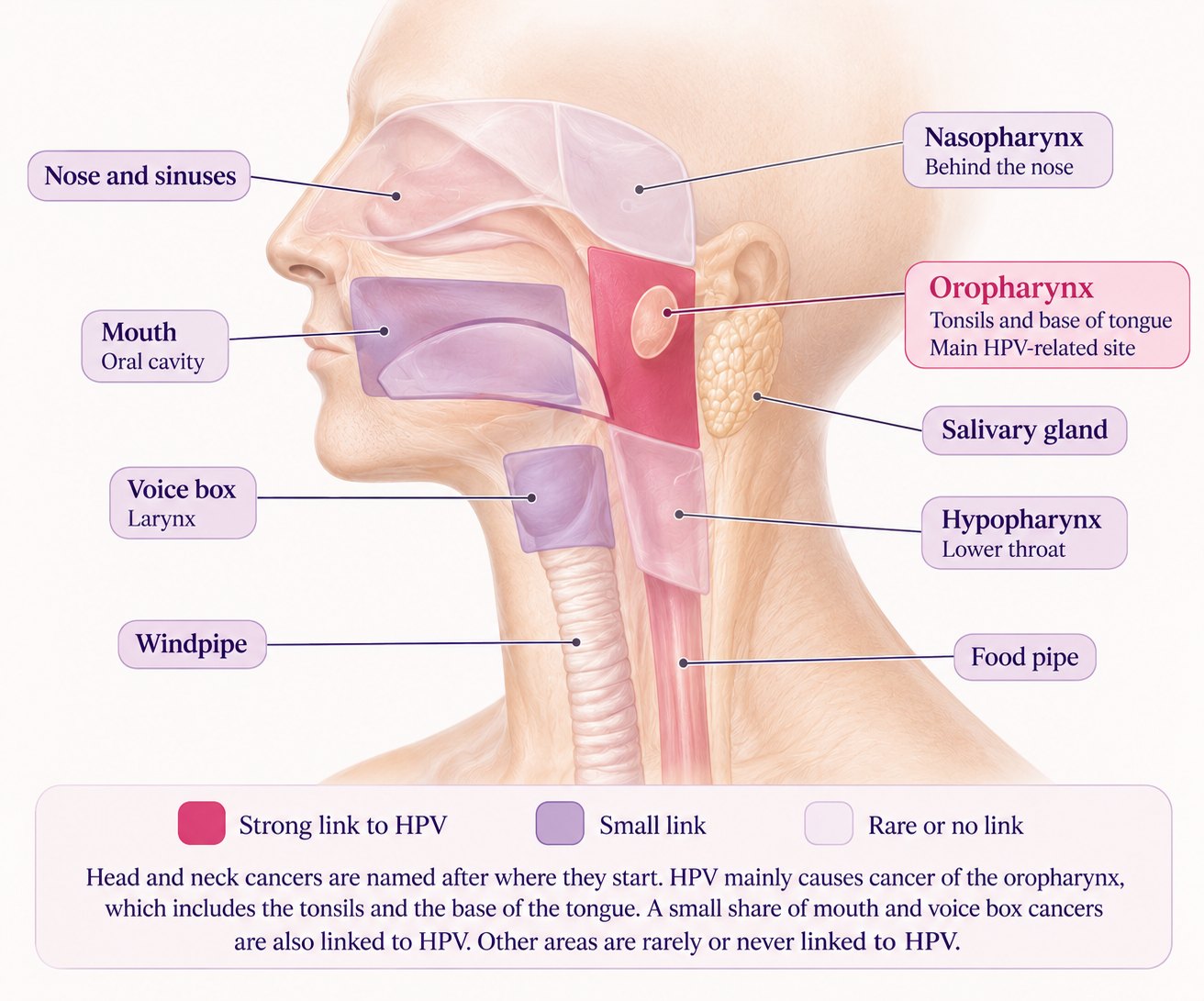
Tap the image to view it larger
Head and neck cancers are named after where they start. They are not all linked to HPV:
| Type | Where it starts | Link to HPV |
|---|---|---|
| Oropharyngeal cancer | The middle of the throat: the tonsils, back third of the tongue, soft palate and throat walls | Strong Around half of UK cases are HPV-positive |
| Mouth (oral cavity) cancer | The lips, gums, front two-thirds of the tongue, floor and roof of the mouth, and inside of the cheeks | Small Around 1 in 12 UK cases. Mostly linked to smoking and alcohol |
| Laryngeal cancer | The voice box (larynx) | Small Around 1 in 10 UK cases. Mostly linked to smoking and alcohol |
| Hypopharyngeal cancer | The lower part of the throat, behind the voice box | Rare Mostly linked to smoking and alcohol |
| Nasopharyngeal cancer | The upper part of the throat, behind the nose | Rare Mostly linked to Epstein-Barr virus (EBV), not HPV |
| Nasal and sinus cancer | The nasal cavity and the air-filled spaces around the nose (paranasal sinuses) | Rare A small number of rare subtypes are HPV-related |
| Salivary gland cancer | The glands that make saliva | None known Not linked to HPV |
HPV shares from UK studies (Schache et al., 2016; Parkin, 2011).
What oropharyngeal cancer is
The oropharynx is the part of the throat just behind the mouth. Doctors divide oropharyngeal cancer into two groups: HPV-positive cancers, caused by the virus, and HPV-negative cancers, mostly linked to smoking and alcohol.
HPV-positive oropharyngeal cancer often affects people who are younger and have never smoked, and it usually responds better to treatment.
Symptoms
Symptoms depend on where the cancer starts. Common signs of head and neck cancer include:
- A lump in the neck, which is often painless and is commonly the first sign of oropharyngeal cancer
- A feeling of something stuck in your throat
- A sore throat that doesn’t go away
- Swelling in the mouth
- A mouth ulcer that doesn’t heal within 3 weeks
- Red or white patches inside the mouth
- Pain or difficulty when swallowing
- A hoarse or changed voice
- Pain in one ear
- A blocked nose or nosebleeds on one side
- Losing weight without trying
See your GP or dentist if you have any of these symptoms and they don’t go away. If they think it could be cancer, they will refer you to a specialist urgently.
Causes
HPV-related head and neck cancer is mainly caused by HPV16, passed on through oral sex and other intimate contact. Most people clear oral HPV naturally, but in a small number the infection persists for many years and leads to cancer, usually in the tonsils or base of the tongue.
Smoking and alcohol cause most other head and neck cancers, and together they increase risk far more than either does alone.
Statistics
Around 9,500 of the yearly head and neck cancer cases are in men. Sources: Cancer Research UK (Schache et al., 2016).
Risk factors
- HPV infection, linked to oral sex and the number of oral sex partners
- Smoking and chewing tobacco
- Drinking alcohol, especially combined with smoking
- Being male. Head and neck cancers are more than twice as common in men
- A weakened immune system, for example from HIV
- Epstein-Barr virus, for nasopharyngeal cancer
How it develops
HPV infects cells deep in the crypts of the tonsils and the base of the tongue. These are folds in the tissue that are hard to see, which is one reason there is no screening test for oropharyngeal cancer and no visible early warning stage like those found by cervical screening.
As in the cervix, the virus’s E7 protein switches off the Rb protein. In response, cells make large amounts of another protein called p16. Laboratories test tumour samples for p16 to tell whether an oropharyngeal cancer is HPV-related, which helps doctors plan treatment.
Diagnosis and treatment
If symptoms last more than 3 weeks, see your GP or dentist. They can examine your mouth and neck and refer you urgently if needed. Specialists may use a thin camera to look at your throat, take a biopsy and arrange scans. Tumour samples are tested for p16 to show whether the cancer is HPV-related.
Treatment may include surgery, radiotherapy and chemotherapy. HPV-positive oropharyngeal cancers usually respond better to treatment and have better outcomes than HPV-negative ones.
Prevention
- Get the HPV vaccine if you’re eligible. Boys have been offered it at school since 2019.
- Stop smoking and cut down on alcohol.
- Use condoms and dental dams for oral sex.
- See your dentist regularly. Dentists check your mouth for early signs of cancer.
Common misconceptions
"Only older smokers and drinkers get throat cancer."
HPV-related oropharyngeal cancer often affects people who have never smoked, and most throat cancers in younger people are HPV-related.
"HPV throat cancer mainly affects gay men."
It’s more common in men than women, but most people affected are heterosexual men in their 40s and 50s.
"Avoiding ejaculation in the mouth prevents HPV."
HPV spreads through skin contact, not body fluids. Condoms and dams reduce the risk, but don’t remove it completely.
Support and charities
- Oracle Cancer Trust: head and neck cancer research and information
- The Mouth Cancer Foundation: support for people affected by head and neck cancers
- Macmillan Cancer Support: practical, emotional and financial support for anyone affected by cancer