Who is eligible
In England, everyone with a cervix aged 25 to 64 who is registered with a GP is invited for screening. Invitations arrive through the NHS App, by text or by letter.
- Trans men and non-binary people with a cervix should be screened. If you're registered with your GP as male or another sex, you may not be invited automatically. Ask your GP surgery, a sexual health service or your gender clinic to arrange invitations, or ask to be booked in every 5 years (or sooner if HPV is found). Screening also applies to intersex people with a cervix.
- Trans women and non-binary people without a cervix don't need screening. If you're invited, you can ask to be removed from the list.
- If you've had a total hysterectomy (womb and cervix removed), you don't need screening. Check with your GP if you're not sure which type you had.
- If you're pregnant, you're usually advised to wait until around 12 weeks after giving birth. Speak to your midwife or GP.
- If you're not registered with a GP, register with one so you can be invited. Sexual health clinics may also offer screening.
- Whoever your partners are and however many you've had, if you've ever had any sexual contact you can have HPV, so screening is recommended.
The move to 5 years is based on strong evidence. A study of 1.3 million women in England found that serious cell changes (CIN3 or worse) were found in 1.21 per 1,000 people screened three years after a negative HPV test, compared with 4.52 per 1,000 after a negative smear test under the old system. A negative HPV test gives much longer protection (Rebolj et al., 2022).
Cervical screening is for people without symptoms. If you have unusual bleeding, discharge or pain, don't wait for or book a routine screening test. See your GP or a sexual health clinic instead.
Scotland and Wales also screen every 5 years after a negative HPV test. In Northern Ireland, people aged 25 to 49 are currently invited every 3 years, and people aged 50 to 64 every 5 years. If you've missed your test, you don't need to wait for a new letter. Contact your GP surgery to book.
What happens at the appointment
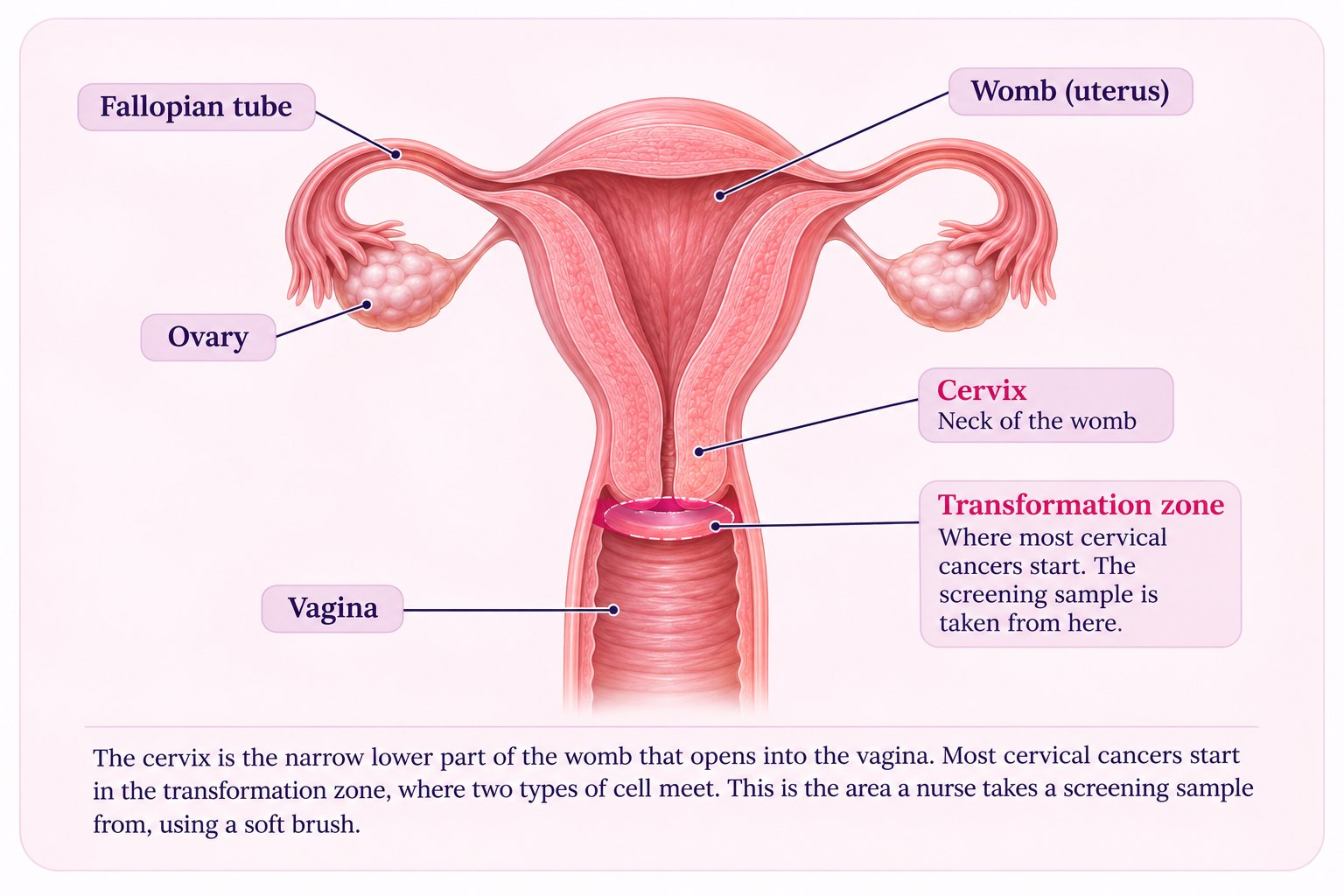
Cervical screening is usually done by a nurse at your GP surgery or a sexual health clinic. The appointment takes about 10 minutes, and taking the sample takes only a minute or two.
- You undress from the waist down behind a screen, and lie on a bed with a paper sheet over you.
- The nurse gently puts a smooth, tube-shaped tool called a speculum into your vagina so they can see your cervix.
- They use a small, soft brush to take a sample of cells from your cervix.
- The speculum is removed and you can get dressed. Your results are usually sent to you by letter.
Barriers to screening and what can help
Nearly a third of eligible people in England aren't up to date with screening. These are some of the most common reasons, and what can make it easier.
If you've been invited but not attended, you may be offered an NHS home testing kit (see below).
Your results
- HPV not found. Your risk is very low. You don't need any further tests, even if you've had abnormal results before, and will be invited again in 5 years.
- HPV found, no cell changes. This is common. You'll be invited for another test in about a year to check if your body has cleared the virus.
- HPV found with cell changes. You'll be invited for a colposcopy, where a specialist looks more closely at your cervix. Any changes can usually be treated there and then. Finding cancer at a colposcopy is very rare.
- Inadequate sample. Sometimes the lab can't get a result. You'll be asked to have the test again in at least 3 months.
Home testing kits
From 2026, the NHS in England is offering HPV self-testing kits to some people who haven't attended screening after previous invitations, starting with those aged 30 to 65. You use a swab to take a sample from your vagina at home and post it back. If HPV is found, you'll be invited for a standard screening test. Home kits are invitation only.
NHS information and support
- Cervical screening: overview
- When you'll be invited
- How to book
- Your results
- Help if you find screening difficult
- GOV.UK: support if you feel anxious about attending
- GOV.UK: easy read guide
- My Body Back Project: screening after sexual violence
- The Eve Appeal: information for trans and non-binary people
Common misconceptions
"I haven't had sex for years, so I can stop going."
HPV can stay in the body unnoticed for many years. Keep going for screening when invited, even if you haven't had sex for a long time.
"A normal result means I can't have any gynaecological cancer."
Screening only checks the cervix. It can't detect cancers of the womb, ovaries, vulva or vagina, so see your GP about any unusual symptoms.
"A smear test tells you if you have cancer."
It's a prevention test. It looks for HPV and early cell changes so they can be treated long before cancer could develop.
"I'm in a same-sex relationship, so I don't need screening."
HPV is passed on through any intimate skin-to-skin contact. Everyone with a cervix should be screened, whoever their partners are.